Lesson 2 · 2 of 20
var, final, const and types · Dart
Declare Dart variables with their type (String, int, double, bool), with var, final and const, and check each value's type with runtimeType.
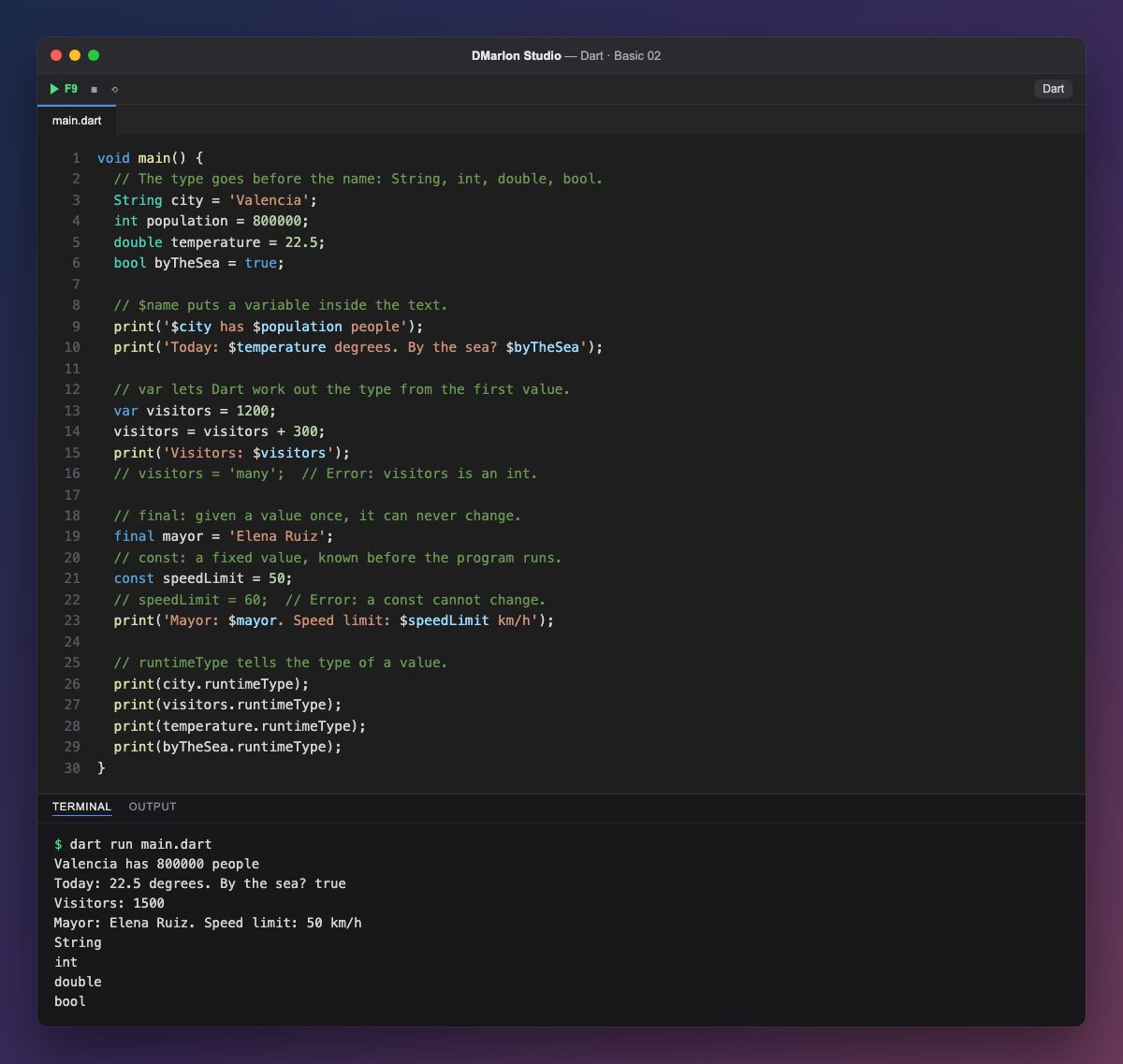
A variable stores a value under a name. In Dart the type comes first and then the name: String city = 'Valencia';. The basic types are String (text), int (whole numbers), double (numbers with decimals) and bool (true or false).
Inside a string, `$name` inserts the variable's value: '$city has $population people' prints Valencia has 800000 people. This is the usual way to build text in Dart; lesson 4 covers it in depth.
With `var` you do not have to write the type: Dart works it out from the first value. var visitors = 1200; creates an int that can change later (visitors = visitors + 300), but it will always be an int: assigning 'many' to it is an error Dart catches before running anything.
`final` gives a value just once: mayor cannot change afterwards. `const` is stricter still: the value must be known before the program runs, like the 50 in speedLimit. Use final or const whenever a value will not change; the code is clearer and safer.
The commented-out assignments show errors on purpose: remove the slashes and Dart will not compile. At the end, `runtimeType` tells the type of each value: String, int, double and bool.
Code · main.dart
void main() { // The type goes before the name: String, int, double, bool. String city = 'Valencia'; int population = 800000; double temperature = 22.5; bool byTheSea = true; // $name puts a variable inside the text. print('$city has $population people'); print('Today: $temperature degrees. By the sea? $byTheSea'); // var lets Dart work out the type from the first value. var visitors = 1200; visitors = visitors + 300; print('Visitors: $visitors'); // visitors = 'many'; // Error: visitors is an int. // final: given a value once, it can never change. final mayor = 'Elena Ruiz'; // const: a fixed value, known before the program runs. const speedLimit = 50; // speedLimit = 60; // Error: a const cannot change. print('Mayor: $mayor. Speed limit: $speedLimit km/h'); // runtimeType tells the type of a value. print(city.runtimeType); print(visitors.runtimeType); print(temperature.runtimeType); print(byTheSea.runtimeType);}Output · dart run main.dart
Valencia has 800000 people
Today: 22.5 degrees. By the sea? true
Visitors: 1500
Mayor: Elena Ruiz. Speed limit: 50 km/h
String
int
double
bool
Key points
- Type, then name:
int age = 29;. varinfers the type, which then stays fixed.finalis set once;constis fixed at compile time.$nameputs a variable inside the text.runtimeTypetells the type of a value.
Exercise
Add a final variable with the name of a river and a const with its length in kilometres, and print a sentence with both plus the type of each.