Lesson 7 · 7 of 20
switch and switch expressions · Dart
Choose between many cases with switch in Dart 3: the classic statement, the new switch expression with =>, patterns such as || and >=, and when guards.
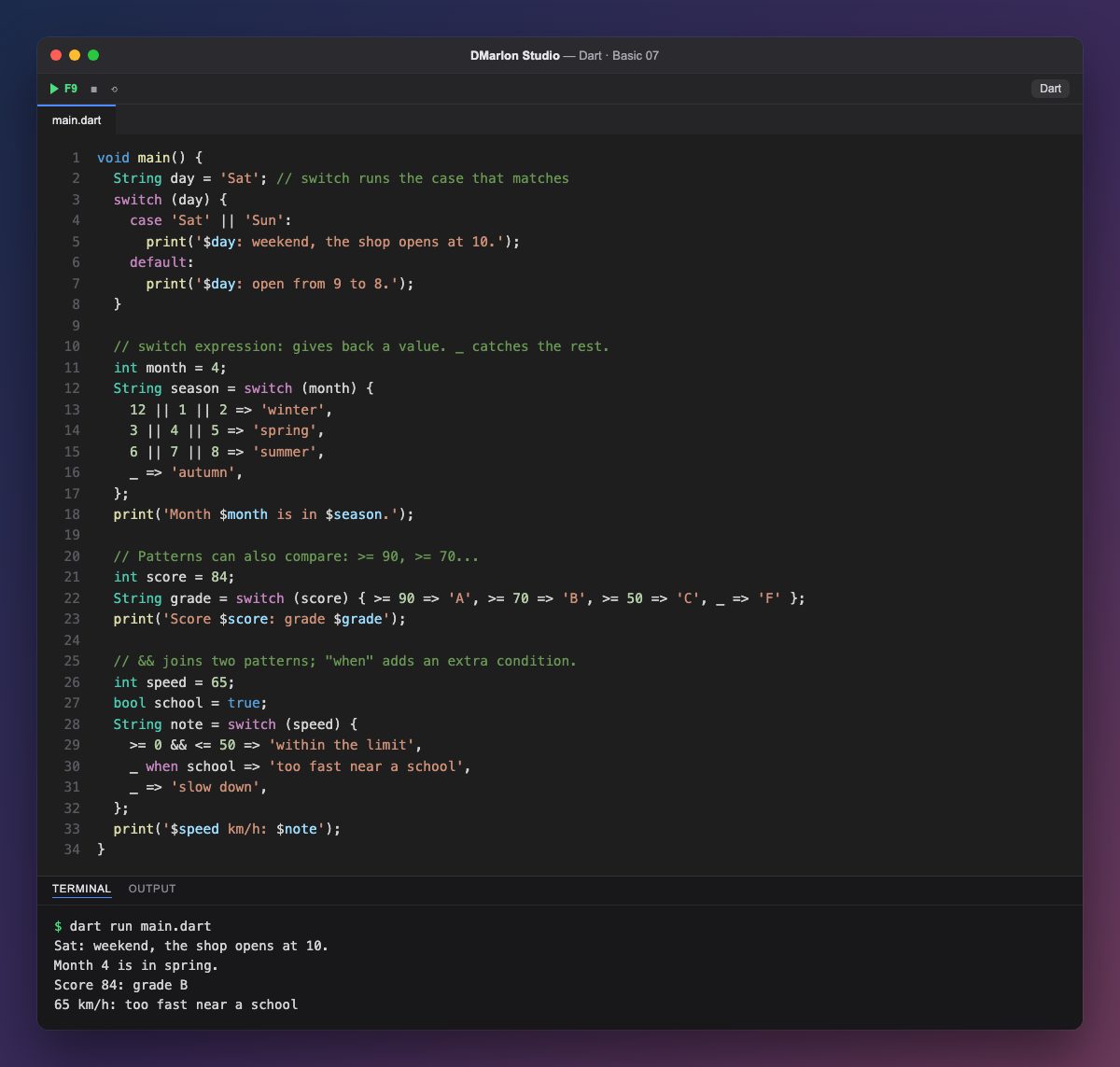
The `switch` statement compares a value against each case and runs the one that matches. In Dart 3 you do not need break: once a case finishes, the switch is over. case 'Sat' || 'Sun': groups two values in one case, and `default` catches everything else.
The `switch` expression is new in Dart 3: instead of running statements, it returns a value, stored here in season. Each case is pattern => value, separated by commas, and `_` is the wildcard that matches anything. With it, picking the season of a month takes just a few lines.
Cases are patterns, and a pattern can compare: >= 90 => 'A' matches any number of 90 or more. Since Dart tries them in order, the score 84 misses >= 90 but matches >= 70, and the whole expression fits on one line.
Patterns combine with `&&`: >= 0 && <= 50 is a range. And `when` adds an extra condition that can look at other variables: _ when school only matches when school is true. That is why 65 km/h gives too fast near a school.
A switch expression must cover every possible case; leave out the _ and Dart complains before running. It is the clearest way to turn one value into another.
Code · main.dart
void main() { String day = 'Sat'; // switch runs the case that matches switch (day) { case 'Sat' || 'Sun': print('$day: weekend, the shop opens at 10.'); default: print('$day: open from 9 to 8.'); } // switch expression: gives back a value. _ catches the rest. int month = 4; String season = switch (month) { 12 || 1 || 2 => 'winter', 3 || 4 || 5 => 'spring', 6 || 7 || 8 => 'summer', _ => 'autumn', }; print('Month $month is in $season.'); // Patterns can also compare: >= 90, >= 70... int score = 84; String grade = switch (score) { >= 90 => 'A', >= 70 => 'B', >= 50 => 'C', _ => 'F' }; print('Score $score: grade $grade'); // && joins two patterns; "when" adds an extra condition. int speed = 65; bool school = true; String note = switch (speed) { >= 0 && <= 50 => 'within the limit', _ when school => 'too fast near a school', _ => 'slow down', }; print('$speed km/h: $note');}Output · dart run main.dart
Sat: weekend, the shop opens at 10.
Month 4 is in spring.
Score 84: grade B
65 km/h: too fast near a school
Key points
- In Dart 3,
casedoes not needbreak. switch (x) { pattern => value, ... }returns a value._matches anything.||,>=and&&build patterns.whenadds a condition to a case.
Exercise
Using a switch expression, turn a day variable from 1 to 7 into the English name of the day, and use _ to give invalid day for any other number.