Lesson 4 · 4 of 20
Classes and inheritance · JavaScript
Write JavaScript classes with a constructor, chainable methods and inheritance through extends and super, using bank accounts.
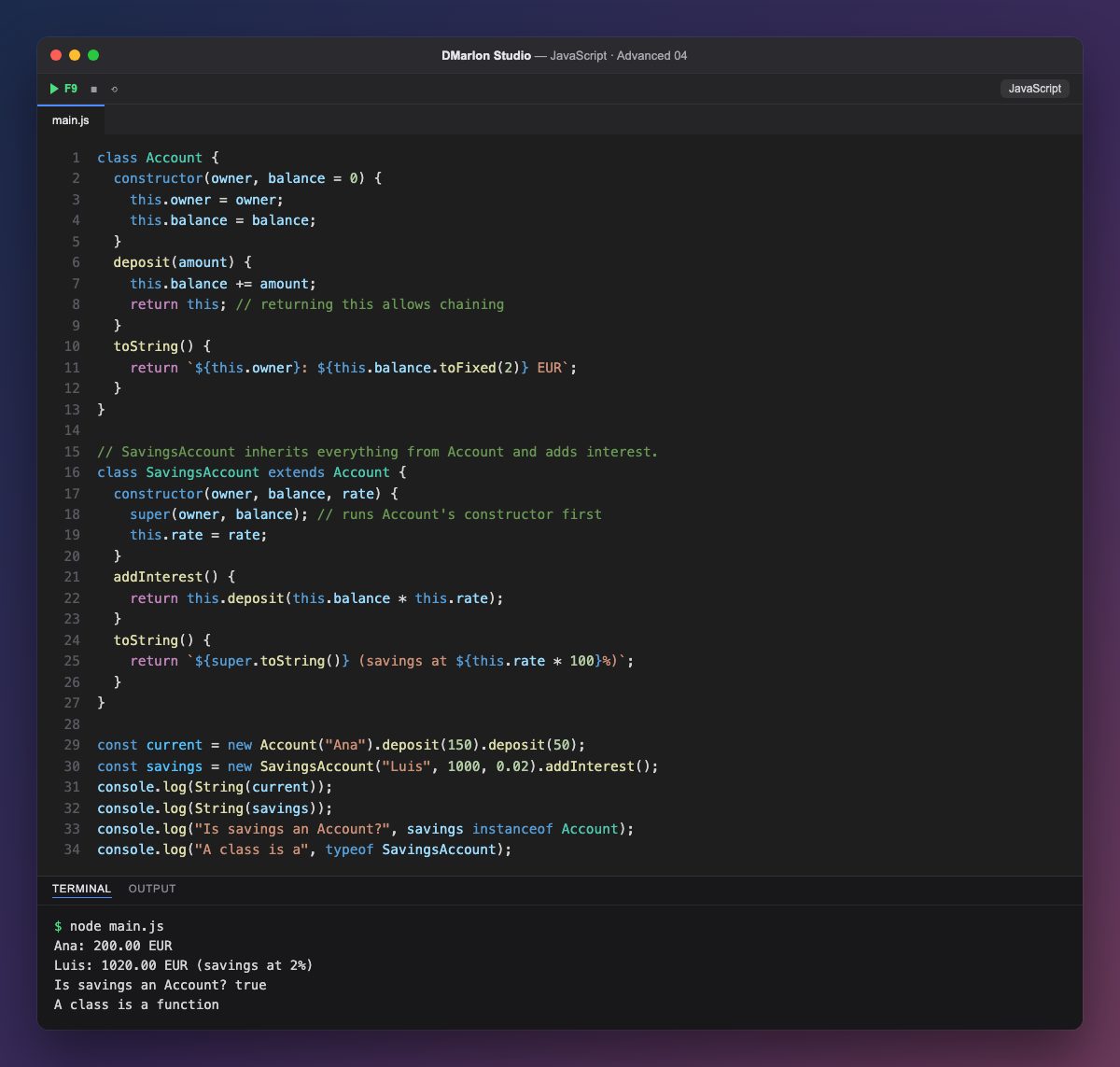
The `class` keyword gives a clean syntax for what the previous lesson did with prototypes. The `constructor` runs with new and sets up the object (owner and balance, which defaults to 0); methods such as deposit and toString end up on Account.prototype, shared by every account.
deposit ends with return this: it returns the account itself, which lets you chain calls, as in new Account("Ana").deposit(150).deposit(50).
`extends` creates a subclass: SavingsAccount inherits everything from Account and adds rate and addInterest(). In its constructor, `super(owner, balance)` calls the parent's constructor, and you must do it before using this. Under the hood, extends links the prototypes: the prototype of SavingsAccount.prototype is Account.prototype.
A subclass can override a method: SavingsAccount's toString() replaces Account's, but reuses the original through super.toString() and appends the interest rate. String(savings) calls that toString. Finally, instanceof confirms that a savings account is also an Account, and typeof reveals that a class is really a function.
Code · main.js
class Account { constructor(owner, balance = 0) { this.owner = owner; this.balance = balance; } deposit(amount) { this.balance += amount; return this; // returning this allows chaining } toString() { return `${this.owner}: ${this.balance.toFixed(2)} EUR`; }}// SavingsAccount inherits everything from Account and adds interest.class SavingsAccount extends Account { constructor(owner, balance, rate) { super(owner, balance); // runs Account's constructor first this.rate = rate; } addInterest() { return this.deposit(this.balance * this.rate); } toString() { return `${super.toString()} (savings at ${this.rate * 100}%)`; }}const current = new Account("Ana").deposit(150).deposit(50);const savings = new SavingsAccount("Luis", 1000, 0.02).addInterest();console.log(String(current));console.log(String(savings));console.log("Is savings an Account?", savings instanceof Account);console.log("A class is a", typeof SavingsAccount);Output · node main.js
Ana: 200.00 EUR
Luis: 1020.00 EUR (savings at 2%)
Is savings an Account? true
A class is a function
Key points
constructorsets up each object created withnew.- Returning
thismakes methods chainable. extendsinherits andsuper(...)calls the parent constructor.super.method()reuses the original method when you override it.- A class is a function that works with prototypes.
Exercise
Create a CheckingAccount class that extends Account, with a withdraw(amount) method that throws an error if the balance would drop below zero, and try to withdraw 300 EUR from an account holding 200.