Lesson 2 · 2 of 20
Variables, types and auto · C++
Declare C++ variables with int, double, char, bool and std::string, protect values with const and let auto work out the type.
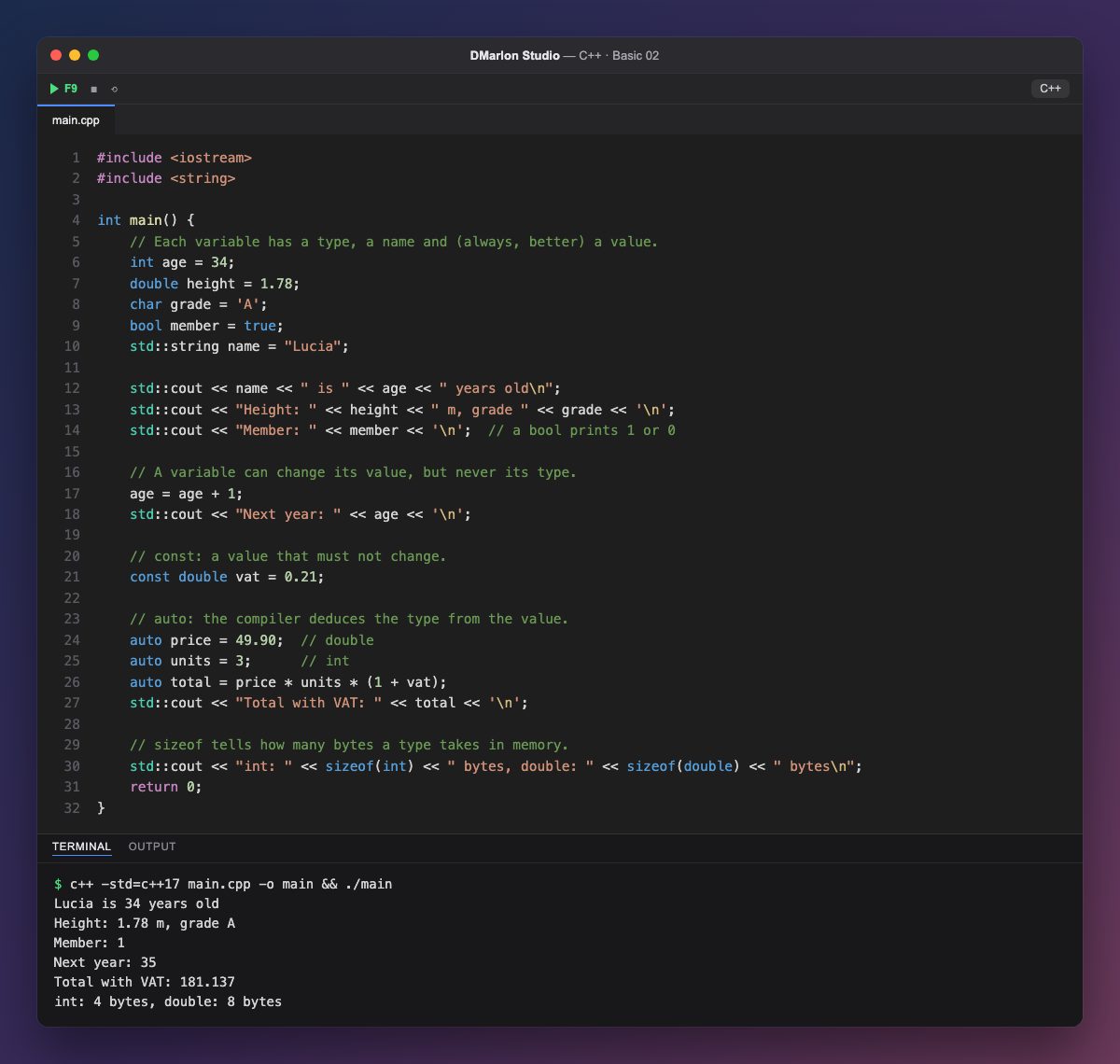
In C++ every variable has a fixed type, written before its name: int for whole numbers (age), double for numbers with decimals (height), char for a single character in single quotes ('A') and bool for true or false. It is good practice to always give them a starting value.
`std::string` holds text in double quotes and needs #include <string>. When you print a bool with std::cout you get 1 (true) or 0 (false); lesson 7 shows how to print true and false instead.
A variable can change its value (age = age + 1) but never its type. The compiler checks types before anything runs, so it catches many mistakes early. With `const`, the value is fixed: if you try to change vat, the program does not compile.
`auto` lets the compiler work out the type from the value: 49.90 makes price a double and 3 makes units an int. It is handy, but the type is still fixed. total mixes both, and the result is a double.
`sizeof` tells you how many bytes a type takes in memory: on a modern computer an int takes 4 and a double 8.
Code · main.cpp
#include <iostream>#include <string>int main() { // Each variable has a type, a name and (always, better) a value. int age = 34; double height = 1.78; char grade = 'A'; bool member = true; std::string name = "Lucia"; std::cout << name << " is " << age << " years old\n"; std::cout << "Height: " << height << " m, grade " << grade << '\n'; std::cout << "Member: " << member << '\n'; // a bool prints 1 or 0 // A variable can change its value, but never its type. age = age + 1; std::cout << "Next year: " << age << '\n'; // const: a value that must not change. const double vat = 0.21; // auto: the compiler deduces the type from the value. auto price = 49.90; // double auto units = 3; // int auto total = price * units * (1 + vat); std::cout << "Total with VAT: " << total << '\n'; // sizeof tells how many bytes a type takes in memory. std::cout << "int: " << sizeof(int) << " bytes, double: " << sizeof(double) << " bytes\n"; return 0;}Output · c++ -std=c++17 main.cpp -o main && ./main
Lucia is 34 years old
Height: 1.78 m, grade A
Member: 1
Next year: 35
Total with VAT: 181.137
int: 4 bytes, double: 8 bytes
Key points
- Type, name and value:
int age = 34;. int,double,char,boolandstd::stringare the basic types.conststops a value from changing.autodeduces the type from the starting value.- A variable never changes its type.
Exercise
Add const int maxPlayers = 4; and auto players = 3;, print how many places are still free, then try to assign a new value to maxPlayers and read the compiler error.