Lesson 15 · 15 of 20
Maps · C++
Store key-value pairs in C++ with std::map: a greengrocer's stock with [], count(), erase() and a walk through the keys in order.
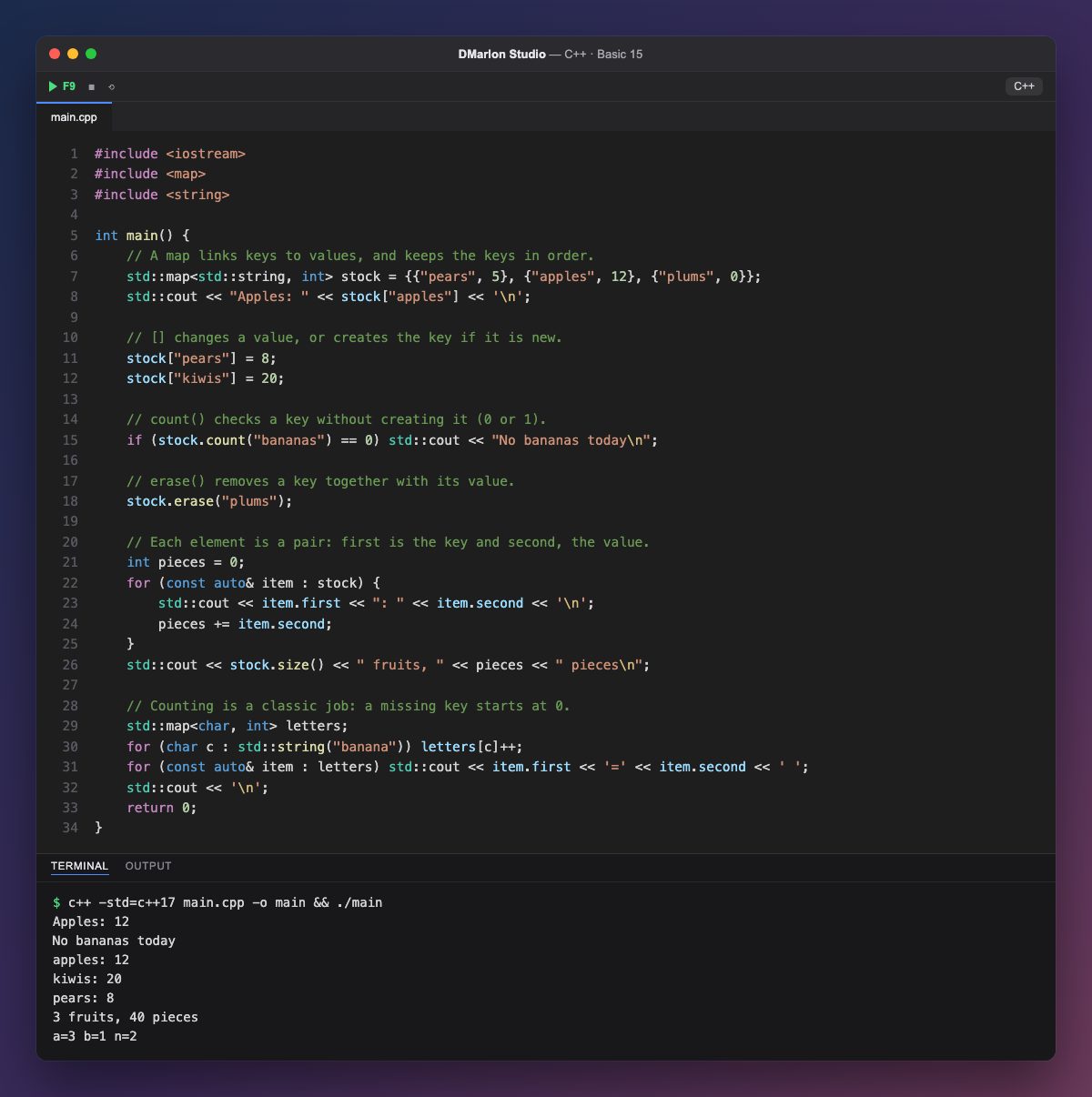
`std::map` links keys to values, like a dictionary. It is declared with both types: std::map<std::string, int> goes from a fruit's name to its amount. It needs #include <map>.
`[]` reads a key's value (stock["apples"] gives 12) and also changes it, or creates the key if it is missing: stock["kiwis"] = 20 adds the kiwis. Careful: merely reading stock["bananas"] would create it too, with the value 0.
To check for a key without creating it there is `count()`, which in a map gives 0 or 1. `erase()` removes a key together with its value. And at(), as with vectors, throws an error if the key does not exist.
A map keeps its keys sorted: walking through it gives apples, kiwis and pears, in alphabetical order rather than the order they were added. Each element is a pair: item.first is the key and item.second the value.
Counting is a classic job: letters[c]++ works even when the letter is not there yet, because [] creates it with 0 and then adds one. That is how the letters in banana are counted.
Code · main.cpp
#include <iostream>#include <map>#include <string>int main() { // A map links keys to values, and keeps the keys in order. std::map<std::string, int> stock = {{"pears", 5}, {"apples", 12}, {"plums", 0}}; std::cout << "Apples: " << stock["apples"] << '\n'; // [] changes a value, or creates the key if it is new. stock["pears"] = 8; stock["kiwis"] = 20; // count() checks a key without creating it (0 or 1). if (stock.count("bananas") == 0) std::cout << "No bananas today\n"; // erase() removes a key together with its value. stock.erase("plums"); // Each element is a pair: first is the key and second, the value. int pieces = 0; for (const auto& item : stock) { std::cout << item.first << ": " << item.second << '\n'; pieces += item.second; } std::cout << stock.size() << " fruits, " << pieces << " pieces\n"; // Counting is a classic job: a missing key starts at 0. std::map<char, int> letters; for (char c : std::string("banana")) letters[c]++; for (const auto& item : letters) std::cout << item.first << '=' << item.second << ' '; std::cout << '\n'; return 0;}Output · c++ -std=c++17 main.cpp -o main && ./main
Apples: 12
No bananas today
apples: 12
kiwis: 20
pears: 8
3 fruits, 40 pieces
a=3 b=1 n=2
Key points
std::map<Key, Value>links keys to values.m[key] = valuechanges or adds.- Reading
m[key]creates the key if it is missing. count()checks a key without creating it anderase()removes it.- Keys always come out in order.
Exercise
Use a std::map<std::string, int> to count how many times each colour appears in a vector {"red", "blue", "red", "green", "blue", "red"} and print the result.