Lesson 13 · 13 of 20
References and const references · C++
See the difference between passing by value and by reference (&) in C++, and use const & to pass vectors and strings without copying them.
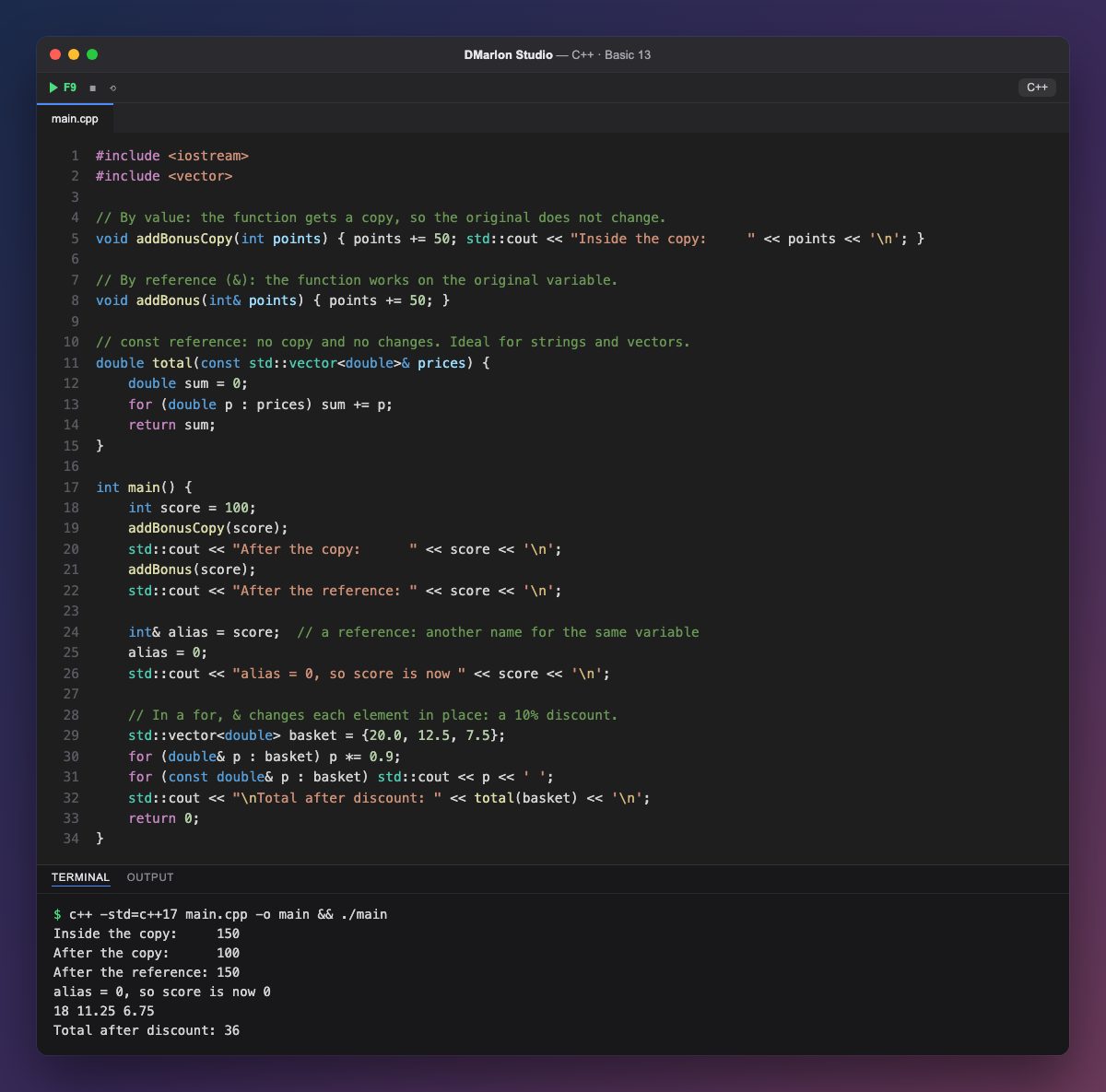
By default C++ passes arguments by value: the function gets a copy. addBonusCopy adds 50 to its copy, which reaches 150, but score is still 100.
With `&` after the type, the parameter is a reference: another name for the original variable. addBonus(int& points) works on score itself, which goes up to 150.
A reference can also be a variable: int& alias = score; creates nothing new, so alias = 0 sets score to 0. A reference stays tied to the same variable from the moment it is created.
Copying a number costs nothing, but copying a vector or a long string does. `const std::vector<double>&` avoids the copy and also promises not to change the original: if total tried to modify prices, the program would not compile. It is the usual way to pass strings and vectors.
In a range-based for, double& p lets you change each element, so the 10% discount ends up applied to basket. For reading only, use const double& p.
Code · main.cpp
#include <iostream>#include <vector>// By value: the function gets a copy, so the original does not change.void addBonusCopy(int points) { points += 50; std::cout << "Inside the copy: " << points << '\n'; }// By reference (&): the function works on the original variable.void addBonus(int& points) { points += 50; }// const reference: no copy and no changes. Ideal for strings and vectors.double total(const std::vector<double>& prices) { double sum = 0; for (double p : prices) sum += p; return sum;}int main() { int score = 100; addBonusCopy(score); std::cout << "After the copy: " << score << '\n'; addBonus(score); std::cout << "After the reference: " << score << '\n'; int& alias = score; // a reference: another name for the same variable alias = 0; std::cout << "alias = 0, so score is now " << score << '\n'; // In a for, & changes each element in place: a 10% discount. std::vector<double> basket = {20.0, 12.5, 7.5}; for (double& p : basket) p *= 0.9; for (const double& p : basket) std::cout << p << ' '; std::cout << "\nTotal after discount: " << total(basket) << '\n'; return 0;}Output · c++ -std=c++17 main.cpp -o main && ./main
Inside the copy:     150
After the copy:      100
After the reference: 150
alias = 0, so score is now 0
18 11.25 6.75
Total after discount: 36
Key points
- By value, the function works on a copy.
- With
type&, it works on the original. const type&avoids the copy and forbids changes.for (auto& x : v)changes the vector's elements.- Pass strings and vectors as
const &when you only read them.
Exercise
Write void applyVat(std::vector<double>& prices), which adds 21% to each price, and double maxPrice(const std::vector<double>& prices), and try them on the basket.