Lesson 15 · 15 of 20
Pointers: address and value · C
Learn what a pointer is in C: a variable's address with &, its value with *, functions that change the caller's variables, and NULL.
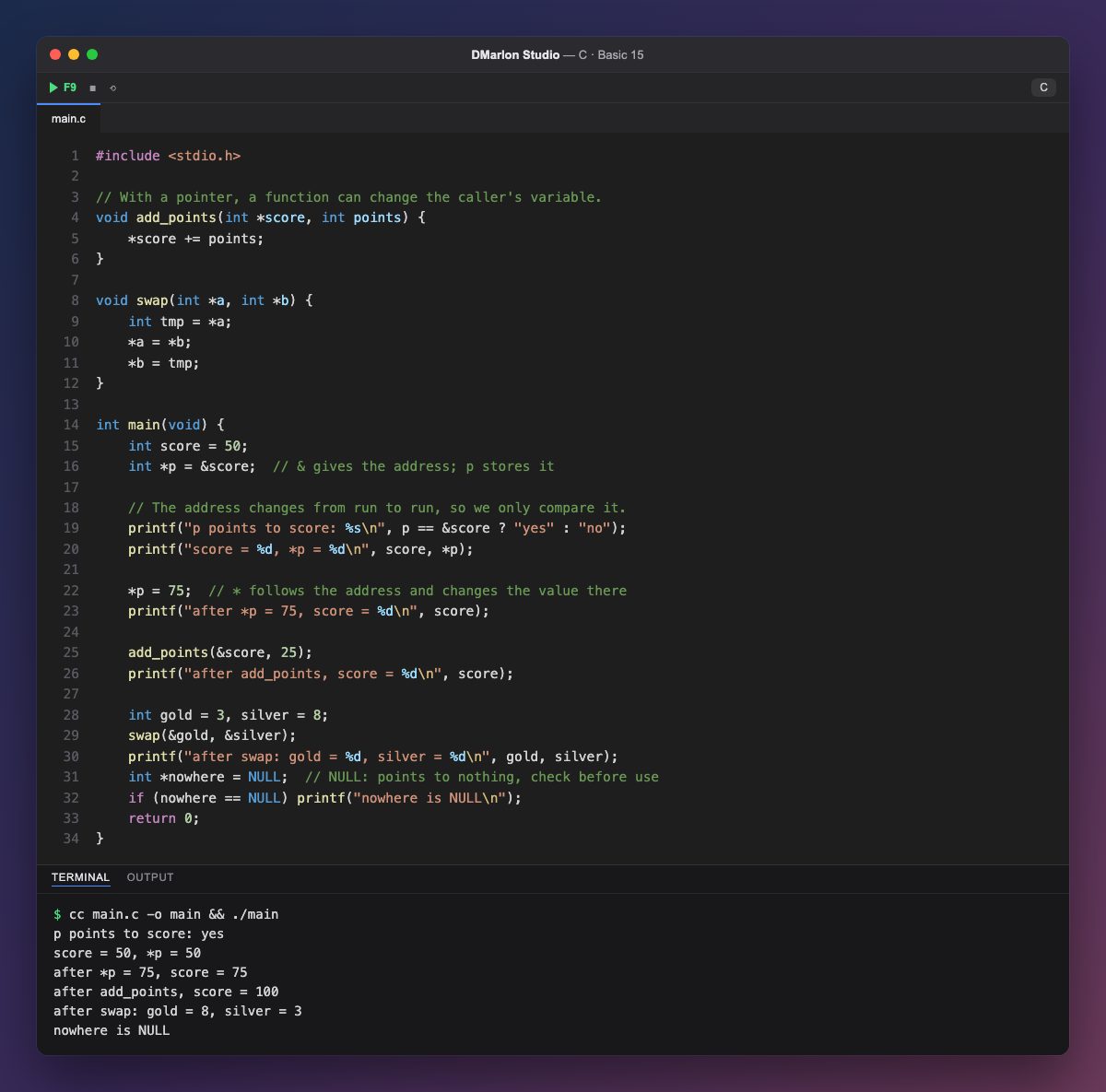
Every variable lives at a place in memory with an address. The `&` operator gives that address, and a pointer is a variable that stores it: int *p = &score; declares p as a "pointer to int" and makes it point at score. The address changes from one run to the next, so the example only checks that p == &score.
The ***** operator in front of a pointer goes to that address: *p is the value of score, 50. It can change it too: after *p = 75, score is 75, because p and score refer to the same place.
Here is what makes pointers so useful. Lesson 13 showed that a function gets copies; if it gets an address instead, it can change the original variable. add_points(&score, 25) adds 25 to score, and swap exchanges gold and silver. That is exactly what scanf does with &age in lesson 5.
`NULL` is a pointer that points to nothing. Before using * on a pointer that might be NULL, check it: reading *nowhere would crash the program.
Code · main.c
#include <stdio.h>// With a pointer, a function can change the caller's variable.void add_points(int *score, int points) { *score += points;}void swap(int *a, int *b) { int tmp = *a; *a = *b; *b = tmp;}int main(void) { int score = 50; int *p = &score; // & gives the address; p stores it // The address changes from run to run, so we only compare it. printf("p points to score: %s\n", p == &score ? "yes" : "no"); printf("score = %d, *p = %d\n", score, *p); *p = 75; // * follows the address and changes the value there printf("after *p = 75, score = %d\n", score); add_points(&score, 25); printf("after add_points, score = %d\n", score); int gold = 3, silver = 8; swap(&gold, &silver); printf("after swap: gold = %d, silver = %d\n", gold, silver); int *nowhere = NULL; // NULL: points to nothing, check before use if (nowhere == NULL) printf("nowhere is NULL\n"); return 0;}Output · cc main.c -o main && ./main
p points to score: yes
score = 50, *p = 50
after *p = 75, score = 75
after add_points, score = 100
after swap: gold = 8, silver = 3
nowhere is NULL
Key points
&xgives the address ofx.int *pis a pointer to anint.*preads or changes the value it points to.- With a pointer, a function can change the caller's variables.
- Check that a pointer is not
NULLbefore using it.
Exercise
Write void split_bill(double total, int people, double *each, double *tip) that stores what each person pays and a 10% tip, and print both values from main.