Lesson 7 · 7 of 20
Comparison and logic · C
Compare values in C with ==, !=, < and >=, and combine conditions with &&, || and !. True is 1 and false is 0; plus the ?: ternary operator.
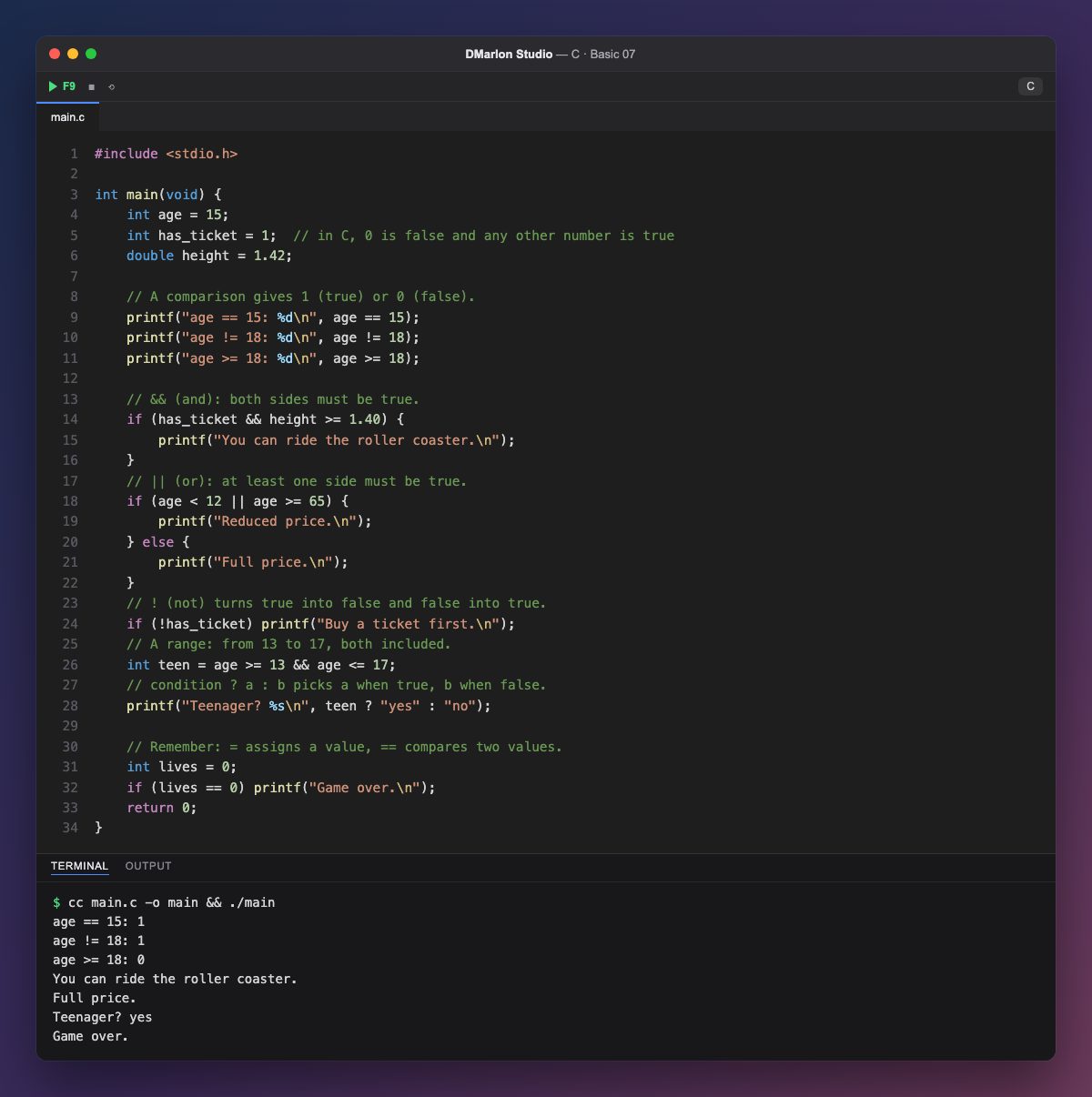
In its most basic form, C has no special type for true and false: 0 is false and any other number is true. That is why a comparison such as age == 15 gives 1 when it holds and 0 when it does not, as the first three lines of output show.
The comparison operators are == (equal), != (not equal), <, >, <= and >=. Do not mix up `==`, which compares, with =, which assigns: if (lives = 0) would store 0 in lives and the condition would always be false.
To combine conditions there is `&&` (and), which needs both to hold, `||` (or), which is happy with one, and `!` (not), which flips the result. With has_ticket set to 1 and a height of 1.42 metres you can ride the roller coaster; at 15 there is no reduced price, and !has_ticket is false, so no ticket is asked for.
age >= 13 && age <= 17 checks a range, and its result (1) can be stored in a variable. The ternary operator teen ? "yes" : "no" picks one value or the other depending on the condition, which is very handy inside printf.
Code · main.c
#include <stdio.h>int main(void) { int age = 15; int has_ticket = 1; // in C, 0 is false and any other number is true double height = 1.42; // A comparison gives 1 (true) or 0 (false). printf("age == 15: %d\n", age == 15); printf("age != 18: %d\n", age != 18); printf("age >= 18: %d\n", age >= 18); // && (and): both sides must be true. if (has_ticket && height >= 1.40) { printf("You can ride the roller coaster.\n"); } // || (or): at least one side must be true. if (age < 12 || age >= 65) { printf("Reduced price.\n"); } else { printf("Full price.\n"); } // ! (not) turns true into false and false into true. if (!has_ticket) printf("Buy a ticket first.\n"); // A range: from 13 to 17, both included. int teen = age >= 13 && age <= 17; // condition ? a : b picks a when true, b when false. printf("Teenager? %s\n", teen ? "yes" : "no"); // Remember: = assigns a value, == compares two values. int lives = 0; if (lives == 0) printf("Game over.\n"); return 0;}Output · cc main.c -o main && ./main
age == 15: 1
age != 18: 1
age >= 18: 0
You can ride the roller coaster.
Full price.
Teenager? yes
Game over.
Key points
- In C, 0 is false and any other value is true.
==compares;=assigns.&&needs both conditions;||needs at least one.!flips a condition.c ? a : bgivesawhencis true,botherwise.
Exercise
Add a with_adult variable and let riders on if they are at least 1.20 metres tall with an adult, or 1.40 on their own, in a single condition using && and ||.