Lesson 6 · 6 of 20
Decisions with if and switch · C
Make decisions in C with if, else if and else, and pick between several cases with switch, case, break and default: temperatures, scores and opening hours.
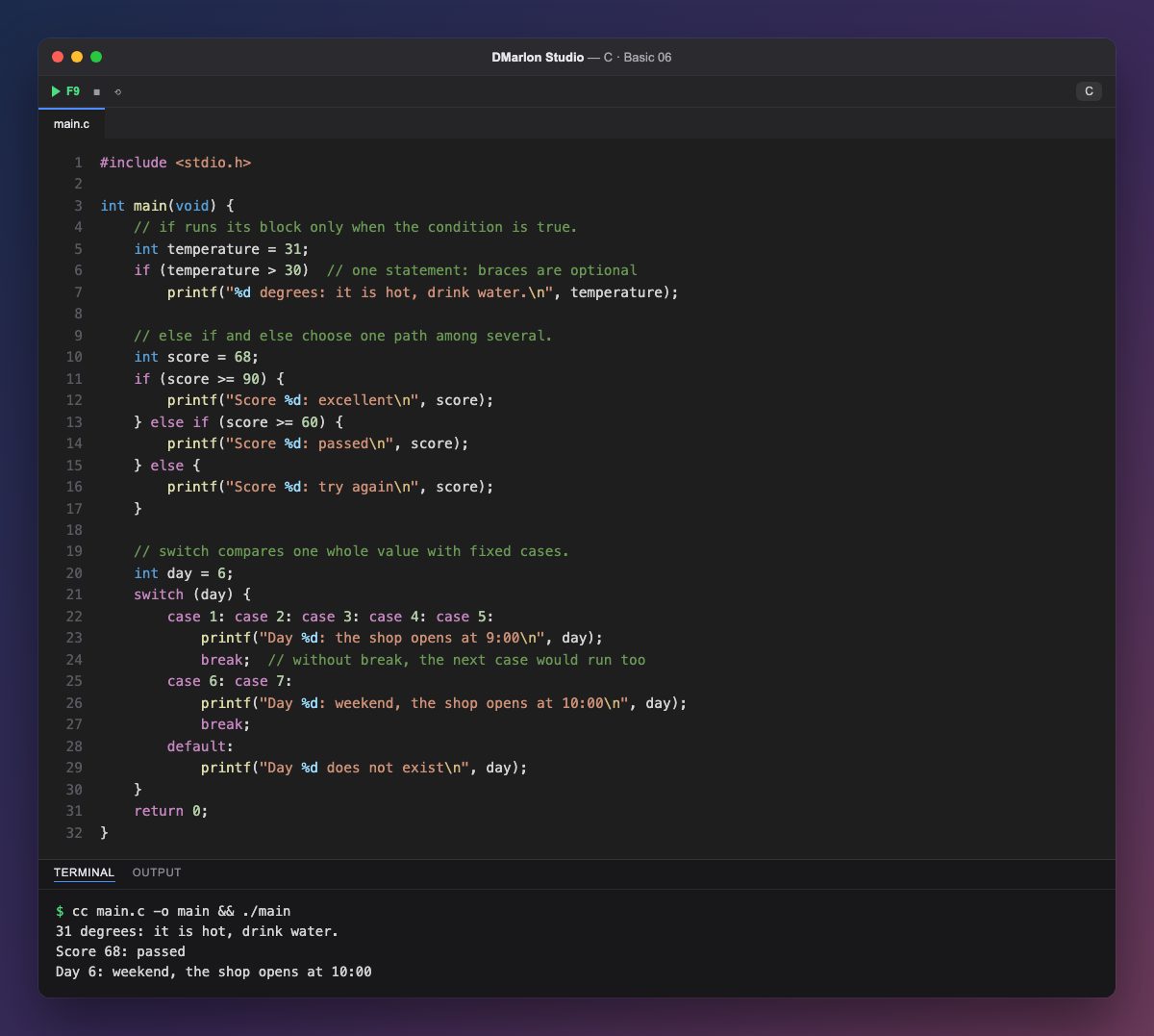
`if` runs a statement or a block only when the condition in brackets is true. At 31 degrees, temperature > 30 holds and the warning is printed. With a single statement the braces can be left out, as here; with several, they are required.
`else if` and `else` pick one path among several. C tries the conditions from top to bottom and runs only the first block that matches: with 68, the first one (>= 90) fails, the second one (>= 60) holds and the else is never looked at.
`switch` compares a whole number with several fixed case values. Cases written one after another share the same code: days 1 to 5 open at 9:00, and 6 and 7 are the weekend. `default` catches any other value.
Each case ends with `break`. Without it, C would carry on running the code of the next case, a very common mistake. Try changing day to 3 or 9 and run it again.
Code · main.c
#include <stdio.h>int main(void) { // if runs its block only when the condition is true. int temperature = 31; if (temperature > 30) // one statement: braces are optional printf("%d degrees: it is hot, drink water.\n", temperature); // else if and else choose one path among several. int score = 68; if (score >= 90) { printf("Score %d: excellent\n", score); } else if (score >= 60) { printf("Score %d: passed\n", score); } else { printf("Score %d: try again\n", score); } // switch compares one whole value with fixed cases. int day = 6; switch (day) { case 1: case 2: case 3: case 4: case 5: printf("Day %d: the shop opens at 9:00\n", day); break; // without break, the next case would run too case 6: case 7: printf("Day %d: weekend, the shop opens at 10:00\n", day); break; default: printf("Day %d does not exist\n", day); } return 0;}Output · cc main.c -o main && ./main
31 degrees: it is hot, drink water.
Score 68: passed
Day 6: weekend, the shop opens at 10:00
Key points
if (condition)runs the block when it is true.else ifandelsepick a single path.switchcompares a whole number with fixed values.- Every
caseneeds itsbreak. defaulthandles the values you did not expect.
Exercise
Add a switch on a char size variable that prints the price of a coffee by size: 'S' 1.20, 'M' 1.60, 'L' 2.00 and, in default, «Unknown size».