Lesson 9 · 9 of 20
Pointers, New and Dispose · Pascal
Work with pointers in Pascal: addresses with @, access with ^, and dynamic memory allocated with New and released with Dispose.
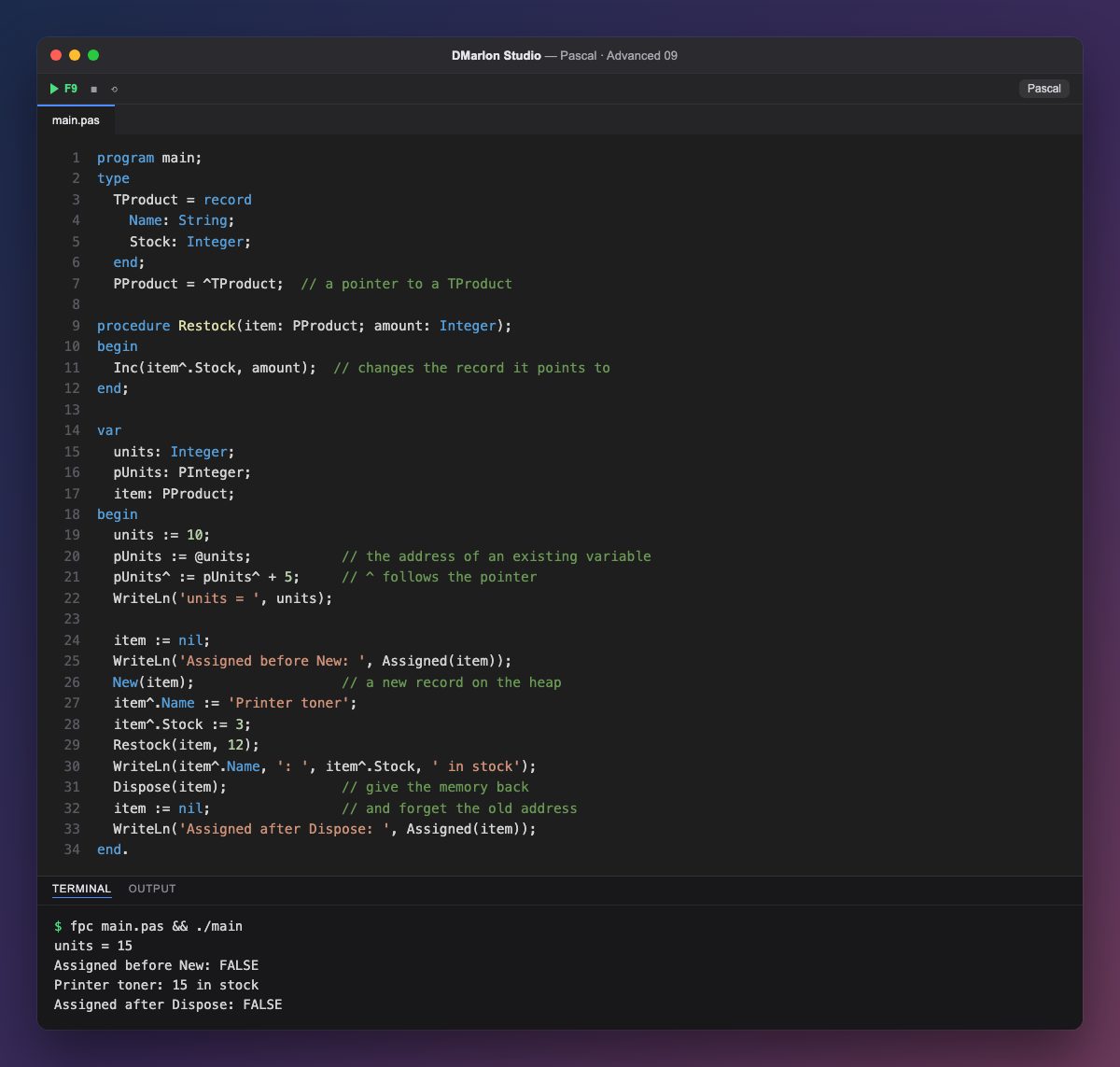
A pointer holds the address of a value, not the value. PProduct = ^TProduct declares a pointer to TProduct, and PInteger comes predefined in the RTL. By convention, pointer types start with P.
`@units` takes the address of a variable that already exists, and `pUnits^` follows the pointer to the value. So pUnits^ := pUnits^ + 5 changes units itself, which goes from 10 to 15. The output never shows addresses: they change on every run and say nothing useful.
`New(item)` allocates a fresh TProduct on the heap and leaves its address in item; it also initialises managed fields such as Name. From then on you work with item^.Name and item^.Stock. Restock receives the pointer and modifies the original record, not a copy.
`Dispose(item)` gives that memory back. What you allocate with New you release with Dispose, exactly once; forget it and you have a leak. Afterwards, set the pointer to `nil` so a released address is never used by mistake, and `Assigned` tells you whether it points at anything.
The objects from earlier lessons are pointers underneath: Create and Free play the part of New and Dispose. Knowing how this works explains why assigning an object only copies the reference.
Code · main.pas
program main;type TProduct = record Name: String; Stock: Integer; end; PProduct = ^TProduct; // a pointer to a TProductprocedure Restock(item: PProduct; amount: Integer);begin Inc(item^.Stock, amount); // changes the record it points toend;var units: Integer; pUnits: PInteger; item: PProduct;begin units := 10; pUnits := @units; // the address of an existing variable pUnits^ := pUnits^ + 5; // ^ follows the pointer WriteLn('units = ', units); item := nil; WriteLn('Assigned before New: ', Assigned(item)); New(item); // a new record on the heap item^.Name := 'Printer toner'; item^.Stock := 3; Restock(item, 12); WriteLn(item^.Name, ': ', item^.Stock, ' in stock'); Dispose(item); // give the memory back item := nil; // and forget the old address WriteLn('Assigned after Dispose: ', Assigned(item));end.Output · fpc main.pas && ./main
units = 15
Assigned before New: FALSE
Printer toner: 15 in stock
Assigned after Dispose: FALSE
Key points
@xis the address ofx;p^is the valueppoints to.Newallocates on the heap;Disposereleases it.- Every
Newneeds exactly oneDispose. - After
Dispose, set the pointer tonil. Assigned(p)tells you whetherppoints at something.
Exercise
Allocate a second product with New, 'Paper A4' with 40 units, print the combined stock of both and release them with Dispose.